sassystud.io

Which AI provider are you actually choosing among?

  • Your own staff, for whom this is not the job (one-off, off-process actions - the so called "shadow AI"),
  • Consulting and services firms (generic solutions),
  • Vertical AI SaaS vendors (still generic),
  • AI agencies for process automation (generic, a bit more flexible, simple projects)?

Off-the-shelf offerings are always sub-optimal on performance (expected metrics differ by user). They only shave marginal cost (the SaaS playbook). True bespoke work takes engineering (code, deployment, evaluation, speed) that is hard to hire and hard to scale.

In 2026, an AI studio is different (and viable) because of:

  • deep AI, engineering, and systems expertise aimed at excellence, and the ability to design any industrial AI system you need,
  • new developer-assist tooling and a methodology proven on those tools, making dedicated solutions workable for engineers and clients alike.

That performance comes with:

  • optimal design from your specifications (we help you articulate and stress-test them), including the high-value topics around AI (see Market fit).
  • zero capex and controlled opex with open-source models (preferably, near-zero inference/token cost), sized with infrastructure from the commercial proposal after audit,
  • corrective maintenance included, delivered by the people who built the system,
  • ongoing support for evolutionary maintenance when you need it (premium).

This is B2B AI, or on-demand AI: not "shadow AI," not a generic product.

Our service is priced at €10 per employee per month.

Audit and, where applicable, build fees are negotiated per engagement on our usual day-rate basis.

We believe shipping a system for a precise, non-trivial need can land in under a month on average. The Stack AI 2025 report (Use cases) shows visual examples of generic systems in that timeframe.

Your build cost stays marginal relative to expected ROI, and our subscription stays flat no matter how many systems you deploy.

“The most promising companies are those tackling the hard work of re-architecting systems around LLMs, building robust agentic systems”.

Rick Sherlund, Founder & CEO, Sherlund Partners, for Goldman Sachs (March 2026)

Our studio

An AI studio is a B2B AI pure play. A close, fast-moving transformation partner with deep AI skills and serious software engineering breadth.

Since 2020 we have designed and deployed high-performance AI systems (search, augmented generation -RAG-, automated design of agentic systems -ADAS-, and B2C applications -eg. media, medicine-). Data- and language-driven, we grew up studying these remarkable language models that start reshaping work across 2/3 of the global economy, and the information systems behind.

Bespoke

Proven model performance (and “agentic” variants) should not trap companies in the myth that only a few vendors can possibly build this. Since ChatGPT landed in 2022, the attention-grabbing products from the big names (e.g. Perplexity) are simply one architecture choice in a sea of options, as countless academic publications since then have only expanded on.

The tools and practices exist to build “reasoning-first” products to your spec and your requirements document. It is a new chapter of software engineering, but it is broadly accessible.

Desk AI is not a durable answer. It is generic, often more expensive than bespoke work, and less profitable at every level.

Solutions

We can implement strong practice on intent, regulation, security, and performance in design and deployment of your AI-orchestrated systems, while retaining IP on the product.

Audit, process review. We push you on where to accelerate or transform. Read our Use cases tab to review those many reported from the industry besides thoughts and directions for businesses and investors.

Our studio can design quite anything, but better, such as:

  • complex or high-value report generation (e.g. OSINT, competitive intelligence),
  • BI, data science tooling, advanced dashboards,
  • a conversational “Excel killer” on top of tabular data,
  • customer- or employee-facing conversational systems that finally query your data,
  • trading, computation, machine learning systems,
  • systems with real-time or safety-critical constraints,
  • opening your site or inventory to consumer or partner AIs (MCP servers).

Industrial agentic system: example

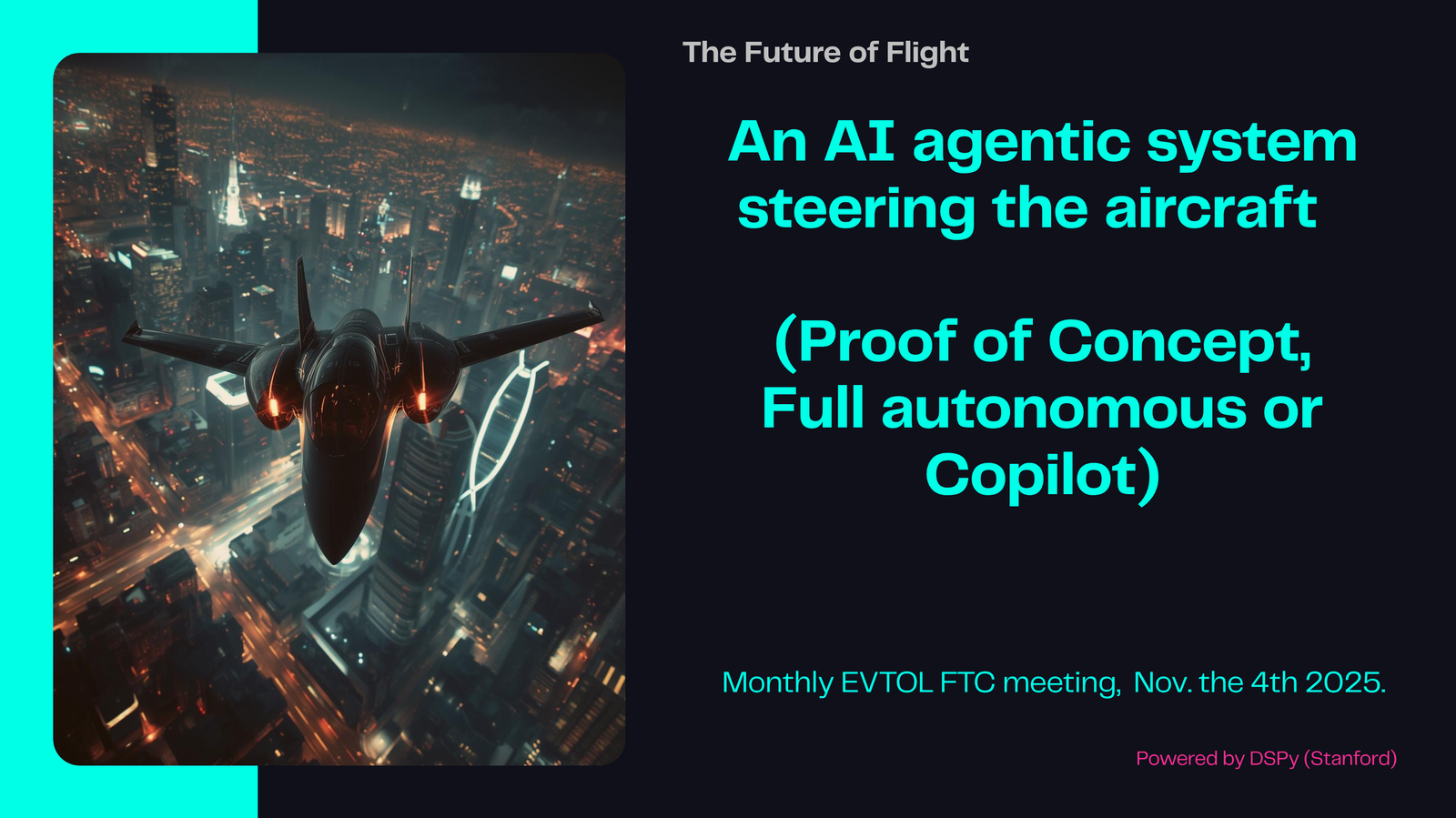
We built this PoC for the eVTOL market (short-term autonomy on the horizon) to show how AI agents can run an air mission and steer it through the usual automation stack.

It required a real-time approach and IPC-style messaging across four agents. Open the deck from our EVTOL FTC meeting (4 Nov 2025): brake-system failure, agent analysis, procedures applied, diversion to a new airport.

The case shows that, contrary to some myths, these systems hit the spec (not “creative” behavior) when requirements are solid and constraints are explicit.

Page 1 — Industrial agentic system: example

Adoption and ecosystem

Our real competitors are the tech giants and their cheerleaders, AI SaaS vendors, and agencies. Their business models will never center on bespoke design.

Beyond performance from your specs and our full-stack expertise (at sharp pricing), our maintenance contracts include SLA close to our infrastructure provider (Google Cloud), faster corrective response, and LLMOps follow-through aligned with the best commitments (reporting, hotline). Systems are maintained by their builders. Tickets give way to direct communication (responsiveness and evolution are contractual). Consultancies will sell shelfware. SaaS vendors will too, at heavy cost.

Beyond the usual hype that inflates complexity and saves vendors time, slow AI adoption is partly about strategic and social implications. Employment impact should be surfaced in audit (it shapes design choices). We think that alone explains a lot of today’s lag and “shadow AI”, as RAG adoption shows with multi-year delays.

Classic AI agencies, for their part, ship simple automations (LLMs when needed), often “good enough”. They cannot train models or optimize RAG algorithms for a specific task (the context-window problem), so they cannot handle the most demanding use cases. Like services firms, they will not tell you, and they cannot manage these problems. Your safeguard would be to specify evaluation benchmarks, but you will be neither competent nor helped on that point.

AI-assisted development tools let a studio keep full control over the codebase, deliver high-quality results, and refine over time a methodology covering every aspect of design that, in turn, shortens execution and iteration time.

See also

THREE NEEDS

AI for your processes

Audit your business, outside perspective on ambition and what is possible. Agentic AI aligned with regulation and your business reality.

AI for your customers

Customer-facing IT: let customers query your data directly. Support 3.0 (conversational, online).

AI in your product

Software vendor? Ship agentic AI in your product to the right standard (fast execution).

REFLECTIONS & USE CASES

Market fit

Topics often framed as blockers: adoption, complexity, strategy. Our take.

Use cases

Studies, market analyses, and many use cases to inform your thinking (by sector or function).