Use cases

Studies, market analyses, and many use cases to inform your thinking (by sector or function).

AI AGENTS

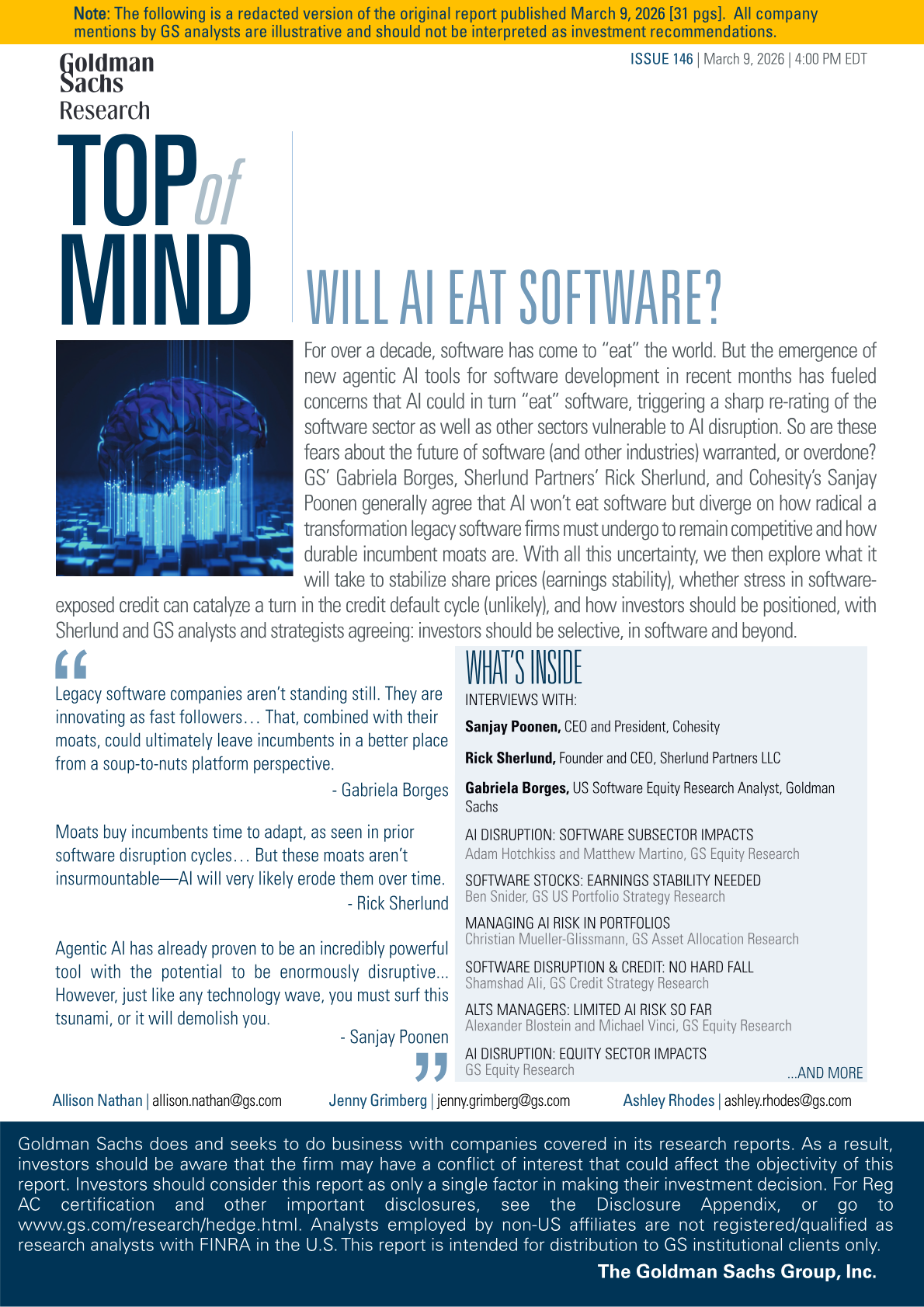
  • Goldman Sachs Research Newsletter (Mars 2026)

    This piece (Will AI eat software?) targets investors: eroding incumbency and sometimes rebuilding from “zero” to stay competitive (with agents at the center). Agents can also ship as new services on their own backends, adjacent to legacy (if performance holds, that can be the pragmatic first step).

    Page 1 — Goldman Sachs Research Newsletter (Mars 2026)
  • Rapport Google Cloud (Shaping the future, mai 2025)

    Growth projections from company documents through May 2025 (a flagship Google piece recruiting services firms and consultancies as “system integrators” in its ecosystem). It nudges them to shift billing and IP toward application-layer bricks (agent libraries, connectors, data, design methodology, marketplaces). 30 use cases across six industries (tech, TMT, financial services, insurance, auto, industrial, public sector, healthcare, life sciences, retail, CPG). As SaaS UIs age awkwardly and agents outperform, do services firms become affiliated design studios? Includes: • methodology and projections on exposed functions and the agentic AI market, • a split between application-layer and services markets (still highly uncertain on services).
    Page 1 — Rapport Google Cloud (Shaping the future, mai 2025)
  • Rapport OpenAI (Identifying and scaling AI use cases, fin 2024)

    OpenAI pushes “Self-serve AI”: employees trained on “six primitives” (atomic tasks) build their own use cases. Google wants integrators. OpenAI wants internal enablement. The report is a manifesto for autonomy and horizontal adoption (“Teaching your teams”): AI so simple the end user becomes the builder. Bottom-up, product-led. Model training and agentic systems come with polished UX. Credible, and still shadow AI: short-term ease without a systems view, experimentation that locks you to proprietary models and ecosystems, then cost drift. Confidentiality and performance stay unsolved because the stack stays generic.

    Page 1 — Rapport OpenAI (Identifying and scaling AI use cases, fin 2024)
  • Rapport IBM — IBM Institute for Business Value | Research Insights (The enterprise in 2030, janvier 2026)

    Only ~20–25% of leaders see how AI lifts ROI. Industry catalogs are inspiration (they still need validation against your specifics, which we do in audit). Value is increasingly framed as innovation over optimization (and growth). Many firms jump to production without deciding whether processes should evolve or transform (see Your processes). A studio is built to innovate: our fast build methods (also AI-accelerated) let you test ideas your teams already surfaced, after the right audit to challenge and advise before you start.

    Page 1 — Rapport IBM — IBM Institute for Business Value | Research Insights (The enterprise in 2030, janvier 2026)
  • Rapport Deloitte (2e semestre 2025)

    ~200 use cases across six industries: consumer; energy, resources & industrials; financial services; government & public services; life sciences & health care; technology, media & telecom.

    Page 1 — Rapport Deloitte (2e semestre 2025)
  • Rapport Stack AI (2025)

    75 use cases: insurance, government, finance, education, private lending, banking, industrials. A LinkedIn note flagged missing topics (permissions, delegation to agents, edge cases needing humans). We ship HIL, full traceability and explainability, and put your domain expertise and control at the center, beyond baseline compliance (see Market fit). Stack’s examples are a starting point. Limited expressivity can suffice for simple cases (typical agency territory).

    Page 1 — Rapport Stack AI (2025)
  • Rapport McKinsey (Novembre 2025)

    88% of firms use AI. Only 39% see EBIT impact. Gap drivers: no process redesign, weak leadership engagement, cost-only focus. ROI math and jobs remain politically sensitive, so conclusions stay soft. ~2,000 respondents across ~100 countries, summer 2025. Agent deployments were near zero a year after the first serious frameworks shipped.

    Page 1 — Rapport McKinsey (Novembre 2025)
  • SAP Business AI use cases (fin 2025)

    200 use cases (procurement, supply chain, HR, e-commerce, etc.) on SAP’s site. SAP argues “agentic AI is the new industrial standard”. We deliver comparable power (agent orchestration, domain RAG) if you are not “all SAP” or want something lighter, more sovereign, and cheaper.

    SAP AI use cases
  • PwC AI use cases (fin 2025)

    Many use cases behind a form (HR, legal, IT, sustainability, operations, sales).

    PwC Applied AI Compass
  • Rapport Gartner (Octobre 2025)

    Gartner puts multi-agent systems (MAS) atop 2026 strategic trends: monolithic AI is out. Orchestrated specialists are in. We meet that with modular architectures and current best practice.

    Gartner report
  • Blog Google Cloud — 1 001 real-world gen AI use cases (Octobre 2025)

    A year+ of industry-shaping gen-AI use cases.

    Google Cloud blog
  • Blog Microsoft — AI-powered success with more than 1 000 stories

    Customer transformation stories on Microsoft Cloud.

    Microsoft Cloud blog

LLM security (conversational interfaces)

  • Agentic AI Threats and Mitigations (OWASP v1.0.1)

    OWASP’s top ten is the reference for web-app security awareness (broad consensus on the most critical risks and a global baseline for safer development).

    Page 1 — Agentic AI Threats and Mitigations (OWASP v1.0.1)

EU regulation

  • Two Cigref reports on the European AI Act. Their intro tempers fears that the rules kill innovation. In Market fit we explain why (beyond extra cost in regulated sectors) many requirements mirror known industrial practice (safety, ergonomics, human factors).

    Page 1 — Page 1 —